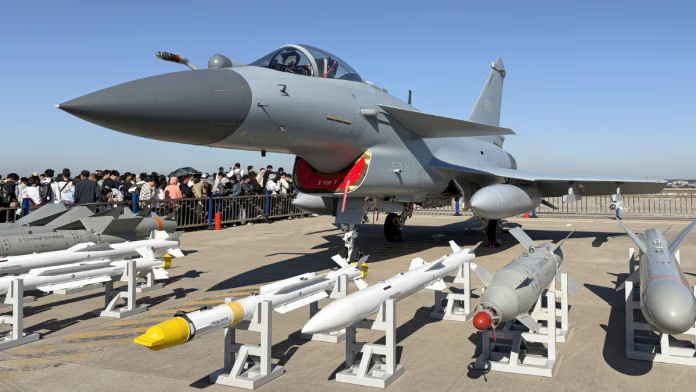
New Delhi | A latest Pentagon assessment on China’s military power has confirmed that China has supplied 36 J-10C multirole fighter jets to Pakistan since 2020, validating long-standing Indian intelligence assessments on Beijing’s expanding defence footprint in South Asia.
The disclosure forms part of the 2025 China Military Power Report, a congressionally mandated document submitted to the US Congress in December 2025. According to the report, 20 J-10C aircraft had been delivered to the Pakistan Air Force (PAF) by May 2025, with the remaining jets scheduled for induction by early 2026. Pakistan currently remains the sole overseas operator of the J-10C platform.
Strategic Implications for the Region
The Pentagon’s confirmation underscores China’s growing role as a defence supplier to Pakistan and highlights the evolving military dynamics in the region. For India, the development reinforces the need for continued strategic vigilance and technological superiority, particularly in the air domain.
Indian defence analysts note that the J-10C induction was aimed at counterbalancing India’s acquisition of the Rafale fighter jets following the 2019 Balakot airstrikes. Pakistan has deployed two J-10C squadrons along sensitive fronts covering Punjab, Jammu and Kashmir, and the Arabian Sea.
Operational Reality After Operation Sindoor
The combat relevance of the J-10C came under scrutiny following Operation Sindoor in May 2025, during which the Indian Air Force (IAF) conducted high-tempo operations. Claims by Pakistan regarding long-range kills using the J-10C and its PL-15 beyond-visual-range missile were later contradicted by satellite imagery and electronic intelligence assessments, according to defence sources.
Operation Sindoor highlighted the IAF’s advantage in sensor fusion, electronic warfare and network-centric operations, with the Rafale fleet—armed with Meteor missiles and the SPECTRA electronic warfare suite—demonstrating clear superiority in contested airspace.
Capability Comparison
While the J-10C features an AESA radar, data links and modern avionics, it is a single-engine fighter designed with cost efficiency in mind. In contrast, India’s Rafales offer twin-engine reliability, supercruise capability and extended endurance, providing a decisive edge in high-intensity operations.
Experts also point to reported limitations of the WS-10 Taihang engine used in export variants of the J-10C, while India continues to invest in a diversified fleet supported by indigenous and collaborative platforms.

India’s Indigenous Push
The Pentagon report comes at a time when India is accelerating its Atmanirbhar Bharat defence strategy. Programmes such as Tejas Mk-1A, Tejas Mk-2 and the Advanced Medium Combat Aircraft (AMCA) are progressing to reduce dependence on foreign platforms and build long-term air power resilience.
India’s air combat capability is further strengthened by indigenous weapons like the Astra air-to-air missiles, Rudram anti-radiation missiles, and advanced electronic warfare systems, alongside force multipliers such as GSAT-7A and RISAT satellites for persistent surveillance.
Broader Geopolitical Context
The report also sheds light on China’s expanding arms export ambitions, now placing it among the world’s top defence exporters. Analysts note that Beijing’s defence ties with Islamabad extend beyond fighter jets to JF-17 co-production and unmanned aerial systems, deepening Sino-Pakistani military integration.
India, meanwhile, continues to enhance partnerships with global allies and strengthen its air defence network through systems such as the S-400, Akash, and automated command-and-control platforms.
Looking Ahead
With 36 Rafales operational, 83 Tejas Mk-1A aircraft on order, and next-generation platforms under development, the Indian Air Force is projected to maintain a clear qualitative edge in the region. Defence experts believe the Pentagon’s disclosure, while highlighting Pakistan’s growing inventory, ultimately reinforces India’s strategy of technology-driven deterrence and indigenous capability building.
The findings transform what Pakistan projected as a strategic milestone into a renewed reminder of India’s emphasis on preparedness, modernisation and air power dominance in an increasingly complex regional security environment.